

Lithium-ion batteries have become a common logistics product, and the volumes stored in European warehouses are growing fast. New batteries, replacement batteries and batteries removed from crashed vehicles move between factories, distributors, sorting centres and recycling hubs. Returns and second-life modules add to these flows.
A warehouse can therefore concentrate hundreds of tonnes of batteries on its racks. A battery is not an ordinary pallet. A shock, overheating or an internal defect can trigger thermal runaway. Insurers are asking a simple question: what is the condition of the goods stored in the building, and what level of risk do they represent? This article presents the decisions taken in Europe to check batteries before they enter storage.

Incoming checks required by insurers
In Germany, incoming inspection is now an explicit requirement from insurers. On 20 February 2026, the Gesamtverband der Deutschen Versicherungswirtschaft (GDV), the federation of German insurers, published a position paper requiring goods to be checked before they enter storage areas. The VdS Schadenverhütung (VdS) 3103 standard treats batteries as a hazardous substance. Only batteries certified under the United Nations Manual of Tests and Criteria, section 38.3 (UN 38.3), may enter the stock, and any damaged battery must be removed immediately. The incoming test therefore becomes a condition set by insurers. This decision followed several fires, including the Durach-Oberkottern fire, which mobilised 150 firefighters in August 2023.
Austria follows a similar approach. Since May 2025, every batch of used batteries must be checked individually on arrival. Any anomaly means that the battery is classified as critical. In Sweden, insurers have warned that simply meeting the minimum regulatory requirements can lead to higher premiums or a refusal of insurance. The Swedish Civil Contingencies Agency, Myndigheten för samhällsskydd och beredskap (MSB), calls for stronger checks when end-of-life batteries are received.
Inspection required in insurance contracts
In the United Kingdom, there is no general legal obligation for this specific test. Insurers can nevertheless include the inspection in their contracts. The Fire Protection Association (FPA) asks operators to check batteries before use. Aviva requires an inspection on arrival and the quarantine of damaged units. American International Group (AIG) treats a state of charge above 30 percent as a warning sign.
In Switzerland, the organisations responsible for cantonal fire insurance require damaged batteries to be quarantined before they enter stock. Above 500 kilowatt-hours (kWh), dedicated rooms and fire compartments are mandatory.
Rules set by states and technical authorities
In France, the response focuses mainly on storage conditions. At Viviez, 1,200 tonnes of batteries burned for five days in February 2024. The official investigation recommends discharging batteries before storage, keeping them in metal drums and limiting storage time. France Assureurs also finances fire tests. Since 1 January 2026, regulations for covered warehouses require sprinklers in high-bay storage cells, fire walls and automatic fire detection.
Denmark requires any storage site above 2,000 kWh to declare the battery type, capacity and state of charge to the local rescue service. In the Netherlands, the Dutch Hazardous Substances Publication Series, Publicatiereeks Gevaarlijke Stoffen (PGS), classifies batteries according to their condition. The Netherlands Institute for Public Safety (NIPV) recommends setting aside suspicious pallets when they arrive. Italy has set a 30 percent state-of-charge ceiling. In the Czech Republic, the Czech Chamber of Authorized Engineers and Technicians Active in Construction, Česká komora autorizovaných inženýrů a techniků činných ve výstavbě (ČKAIT), recommends monitoring the entrance to areas holding damaged batteries.
Note that some sites use thermal cameras at the entrance. A camera only sees the battery’s surface temperature. It cannot detect the actual condition of a battery that has suffered a shock or has an internal defect.
Voluntary measures by logistics operators
Major logistics operators have introduced voluntary measures without waiting for regulations. Many check batteries on arrival and record the condition of each unit so that it can be directed to dismantling, reuse or recycling. Others monitor pallets and move suspicious units to a dedicated area.
Several operators refuse defective batteries on arrival. Floodable quarantine containers are appearing at specialised sites. These practices show the processes that insurers are beginning to request.
The FM Global reference
Behind these practices is a technical reference used well beyond the United States: the documents of FM Global, an insurer founded in 1835. Data Sheet 7-112 (DS 7-112), published in October 2024, requires damaged or returned batteries to be isolated and limits block storage to a maximum state of charge of 60 percent. German VdS compares this document with its own recommendations, and Swiss Re cites it in its guides.
Batcapt as a decisive incoming check
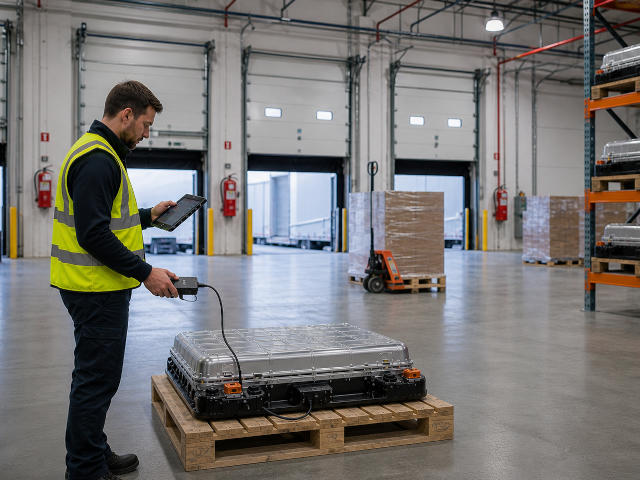
Batcapt provides a diagnostic solution designed for incoming testing of high-voltage batteries. Its flash diagnostic checks state of charge (SoC), state of health (SoH) and state of safety (SoS). By accessing the sensors at the heart of the battery, the system uses the voltage of each cell and the internal temperatures to assess battery stability and identify an anomaly.
The result is presented in a simple format, with a green, orange or red classification. Operators have an immediate basis for routing the battery correctly. Results are centralised and provide a precise view of stock condition. Measurement traceability is maintained.
Conclusion
European rules still vary widely from one country to another, and harmonisation will take time. This diversity does not remove the need for operators to check a battery’s condition before storage, identify units that must be isolated and keep a record of that decision. Incoming inspection is therefore becoming a basic safety practice, whatever the local rules may be.
Reference documents
- Gesamtverband der Deutschen Versicherungswirtschaft (GDV), position paper, 20 February 2026 : https://www.gdv.de/resource/blob/197042/5822901610f4dd8327858fc849184b7e/positionspapier-zur-einstufung-von-lithium-batterien-im-transport-data.pdf
- VdS Schadenverhütung (VdS) 3103 Lithium-Batterien : https://vds.de/fileadmin/Website_Content_Images/VdS_Publikationen/vds_3103_web.pdf
- Bureau of Investigation and Analysis of Industrial Risks (BEA-RI), Viviez fire report (2025) : https://www.faceaurisque.com/wp-content/uploads/2025/05/Rapport-enquete-BEA-RI-incendie-batteries-Sopave-Viviez-.pdf
- France Assureurs, Centre national de prévention et de protection (CNPP) fire tests : https://www.franceassureurs.fr/actualites/batteries-lithium-ion-campagne-essais-feu-cnpp/
- Fire Protection Association (FPA) RE2, Lithium-ion Battery Use and Storage : https://rowlands-hames.co.uk/wp-content/uploads/2024/07/lithium-use-and-storage.pdf
- Aviva, Loss Prevention Standard lithium-ion batteries : https://static.aviva.io/content/dam/document-library/risk-solutions/lithium_ion_batteries_storage_and_transit_lps.pdf
- Publicatiereeks Gevaarlijke Stoffen (PGS) 37-2, Lithiumhoudende energiedragers Opslag : https://publicatiereeksgevaarlijkestoffen.nl/publicaties/online/pgs-37-2/2023/1-1-april-2026
- Netherlands Institute for Public Safety (NIPV), Li-ion scenario books : https://scenarioboeken.nipv.nl/brand-in-opslag-van-li-ion-accus/
- Vienna MA 36 directive, storage and use of Li-ion batteries : https://www.wien.gv.at/pdf/ma36/lagerung-verwendung-lithium-ionen-batterien.pdf
- Association of Cantonal Fire Insurance Establishments (VKF/AEAI) 2005-15 Lithium-Ionen-Batterien : https://services.vkg.ch/rest/public/georg/bs/publikation/documents/BSPUB-1394520214-3688.pdf/content
- Föreningen för brandteknisk ingenjörsvetenskap (BIV), PM egendomsskydd, December 2025 : https://sfpe-biv.se/wp-content/uploads/2025/12/BIV-PM-egendomsskydd_9-dec_remiss.pdf
- Beredskabsstyrelsen, guidance 2023 : https://www.brs.dk/globalassets/brs—beredskabsstyrelsen/dokumenter/forebyggelse/2023/-vejledning-om-brandsikring-af-storre-oplag-af-litiuimionbatterier-samt-bess-.pdf
- Vigili del Fuoco (VVF) and Italian National Agency for New Technologies, Energy and Sustainable Economic Development (ENEA) study, lithium storage risks : https://www.pro-fire.org/images/RischiConnessiConLoStoccaggioDiSistemiDiAccumuloLitio-Ione_V2.pdf
- Czech Chamber of Authorized Engineers and Technicians (ČKAIT) recommendation, Elektromobilita : https://www.ckait.cz/sites/default/files/2021-09/Metodicke_doporuceni_Elektromobilita_PB_21_04_19.pdf
- FM Global Data Sheet 7-112 : https://www.fm.com/FMAApi/data/ApprovalStandardsDownload?itemId=%7B569D0125-7BB1-43D6-84E0-8B9374BE0C99%7D