

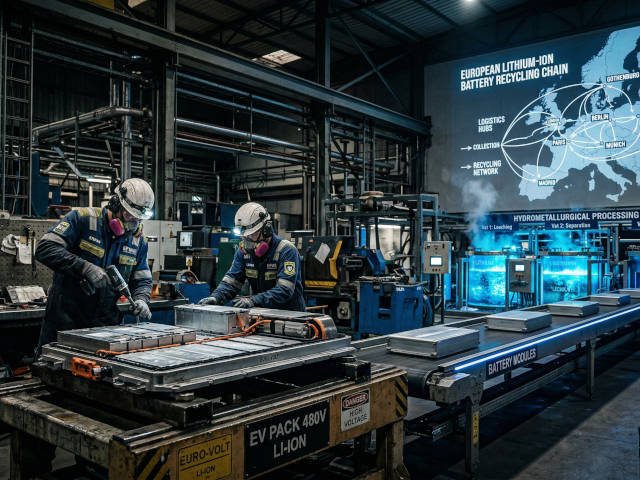
A landmark study published in Waste Management (Elsevier, 2025) sheds critical light on the economic and structural barriers that prevent lithium-ion battery recycling from becoming a viable industry in Europe. Based on expert interviews with 13 stakeholders across the battery value chain — OEMs, logistics providers, and recycling companies — this peer-reviewed research goes beyond technical analysis to deliver rare, market-grounded insights.
The Study: Why It Matters
Published in Waste Management (Volume 205, 2025, Elsevier), this open-access research paper by v, Christopher Weinert, Valentin Mussehl, Moritz Frieges, and Achim Kampker from RWTH Aachen University (PEM) is one of the first studies to assess battery recycling from a full system-level perspective — from collection to hydrometallurgy — integrating stakeholder perspectives rather than isolated technical metrics.

With Europe targeting 3,500 GWh of traction battery demand by 2030, and the EU classifying lithium, cobalt, and graphite as critical raw materials, the stakes could not be higher. This study provides the most comprehensive picture to date of why the recycling value chain is struggling — and what a viable architecture would look like.
Abstract (verbatim)
Given the critical importance of lithium-ion batteries in the electric vehicle market and the limited availability of critical raw materials like lithium, cobalt, and graphite, effective and profitable battery recycling processes are vital for reducing European dependency on imports and enhancing the sustainability of batteries. The analysis of economic and structural challenges of lithium-ion battery recycling is based on expert interviews with 13 stakeholders in the battery value chain, including vehicle manufacturers, logistics providers and recycling companies. The investigated processes include battery collection, classification, transport, intermediate storage, mechanical treatment, and chemical processing. The findings confirm that current recycling practices are not profitable: transport can account for up to 70% of total recycling costs, chemical processing infrastructure requires investments of around 23 euros per kg of input material, and many recycling plants operate at less than 10% of their capacity due to insufficient battery return volumes. To address these challenges, a decentralized structure is proposed, with regional pretreatment facilities and centralized chemical processing hubs, to reduce transport distances, lower costs, and improve scalability.
Key Findings
The study confirms what many in the industry suspect but few quantify:
- Transport costs can represent up to 70% of total recycling costs, driven by safety regulations, certified packaging, and low return volumes that prevent load optimization.
- Recycling facilities operate at 5–10% of their traction battery capacity, relying on consumer electronics batteries and production scrap to fill the gap.
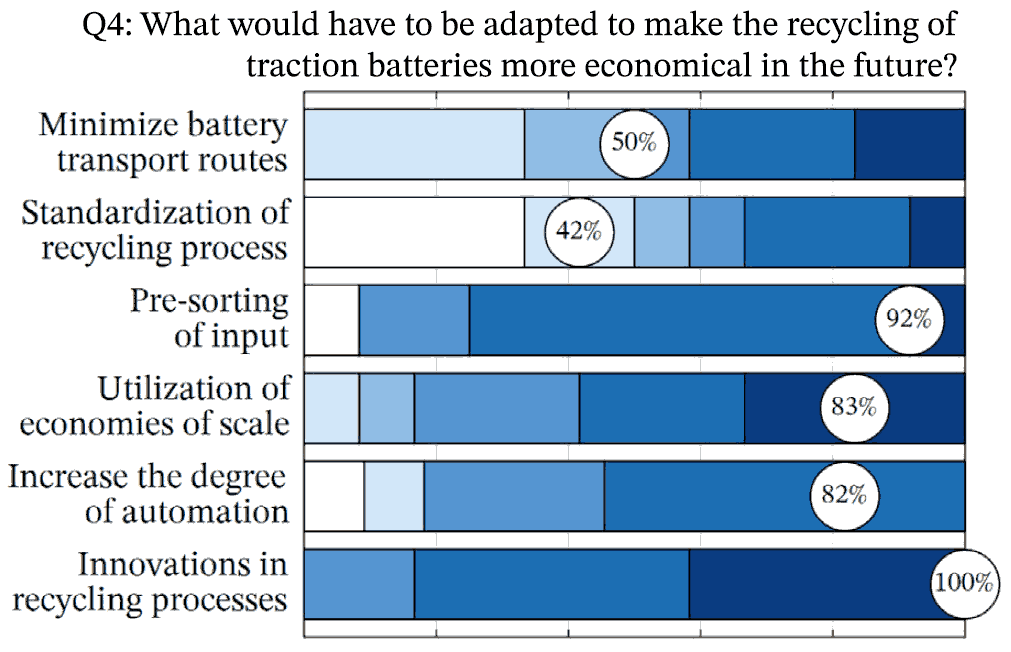
- Chemical processing (hydrometallurgy) requires investments of approximately €23/kg of input material, making it the single largest cost driver — rated significant by 92% of participants.
- 100% of participants confirmed that European black mass is predominantly sold to markets outside Europe — mainly Korea, China, and the US — because Asian buyers offer more competitive prices.
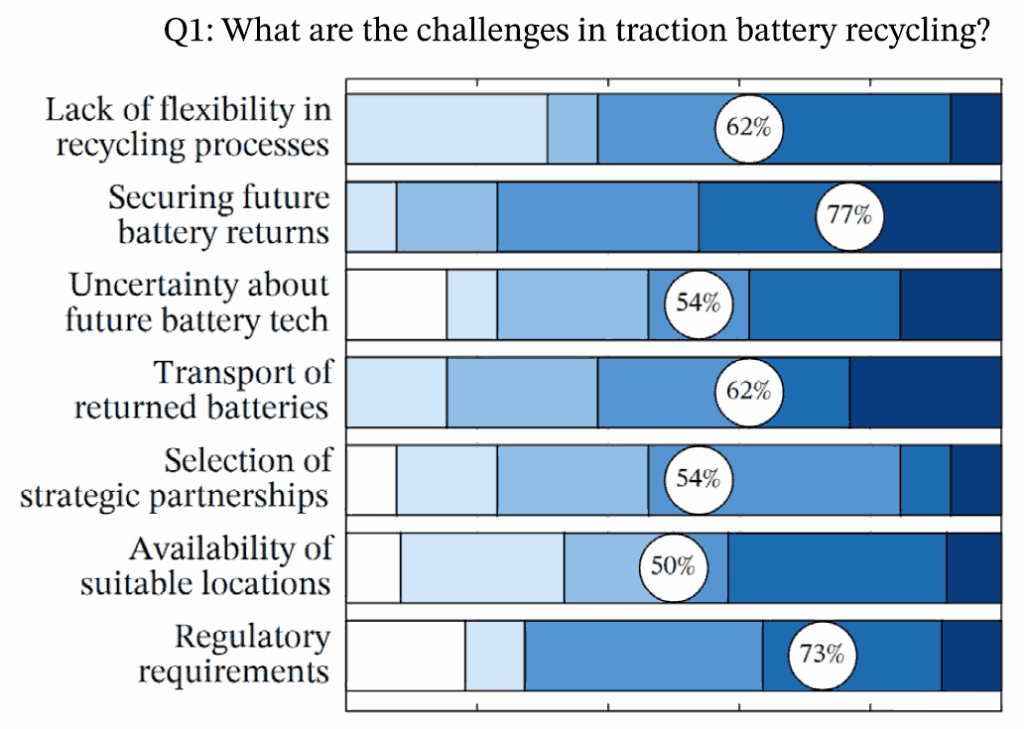
- 82% of participants identified the lack of transparency on battery status and composition as a major transport obstacle.
- A spoke-and-hub structure — regional pretreatment hubs feeding centralized chemical processing facilities — is endorsed by 100% of participants as the right structural response, though practical implementation strategies remain underdeveloped.
What Batcapt Is Doing About It
The study highlights two structural bottlenecks where actionable solutions are urgently needed: battery classification before transport and pre-sorting of incoming batteries at recycling facilities.
92% of participants identified pre-sorting as a critical factor for improving economic efficiency. They called explicitly for “tools in the industry that enable the identification of battery chemistries in packs or modules without disassembling them first.” Battery diagnostics remain too slow and too costly, especially at the cell or module level.
This is precisely what Batcapt was built to solve.
Batcapt develops non-invasive monitoring and diagnostic solutions for high-voltage lithium-ion battery packs. Our devices connect directly to the battery BMS through the communication ports already present on the pack — no disassembly required. They instantly read the battery’s state of health (SOH), chemistry, and safety classification, delivering the structured data needed to:
- Classify batteries before transport (end-of-life, defective, or critically defective) as required by ADR regulations — reducing transport costs and safety risks
- Pre-sort incoming batteries at recycling facilities by chemistry and condition, eliminating mislabeling errors and improving process efficiency
- Feed data to the cloud so logistics operators, SAV teams, and recyclers share a common, reliable battery information the downstream lifecycle
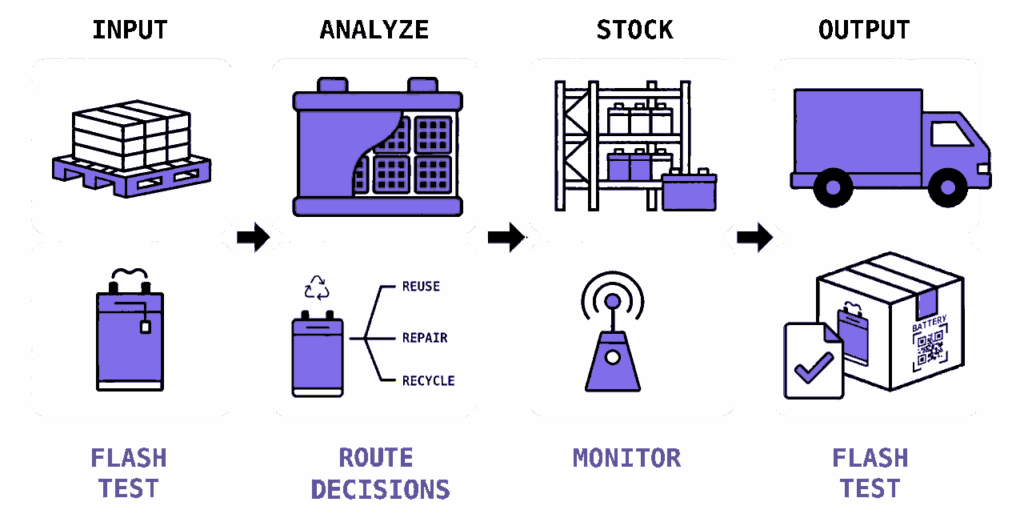
Where the study identifies diagnosis as a bottleneck, Batcapt provides the answer: fast, non-destructive, standards-compliant battery intelligence — deployable at every node in the recycling chain.
The Road Ahead
The 2023 EU Battery Regulation is already pushing OEMs to take greater responsibility for downstream battery lifecycle management. As return volumes grow toward 2030, the pressure to classify, transport, and recycle batteries cost-effectively will only intensify.
The industry needs more than chemistry and engineering — it needs data. Batcapt is building the diagnostic infrastructure that makes the spoke-and-hub recycling chain economically viable.
Source: Soldan Cattani N., Weinert C., Mussehl V., Frieges M., Kampker A. — “Economic and structural challenges of lithium-ion battery recycling in Europe: A stakeholder-based assessment” — Waste Management 205 (2025) 114962 — https://doi.org/10.1016/j.wasman.2025.114962
A local copy is also available here